


























#months #shelling #Mykolaiv #normal

Six months after the start of the Russian invasion, residents of Mykolaiv feel fear and resignation as daily shelling of their southern Ukrainian city becomes a new routine.
In the Sukhii Fontan (Dry Well) district, a dozen people with empty jerry cans chat while queuing for drinking water.
A water main was disabled during fighting in April.
The water is running again, but it is salty and the only way to get drinking water now is to go to the distribution points set up in each district.
But water is far from the main concern.
“The other day there was an explosion next to my apartment. It’s awful, but the scariest part is that I’ve adapted,” said Eva Gudzon, a 35-year-old singer and photographer.
“I don’t sleep at night anymore. I just lie there and wait for the strikes. It messes with my body clock and I still have to take care of my children during the day,” she said.
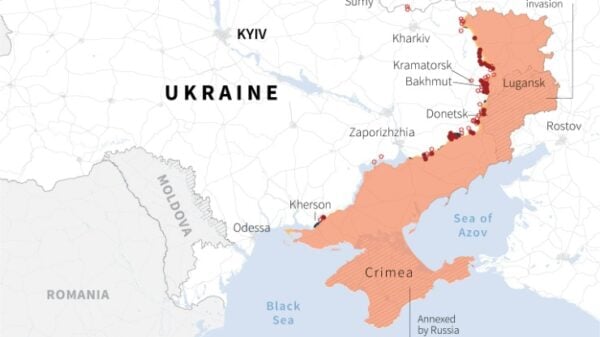
Mykolaiv, which sits on a river estuary just off the Black Sea, was almost encircled and captured by Russian troops early in the war.
It was a crucial objective for the Russian army hoping to secure a route to Odessa – Ukraine’s largest port – and eventually seize control of Ukraine’s entire Black Sea coast.
To avoid this fate, Ukraine put up a fierce struggle and managed to push back Russian forces.
Russia’s grip on Mykolayiv has since loosened, but the shelling never stopped.
The deadliest, a March 29 strike on administrative buildings, killed 37 people, including many city employees.
– ‘Get on with your life’ –
The economy is also on the ground.
500,000 people used to live in the city. Now the port is under a Russian blockade and the shipyards are at a standstill.
Some manage to catch their breath: youths, willfully ignoring the “no swimming” sign, have taken over an abandoned yacht club.
The city center and its restaurants are also surprisingly lively. Most customers are off-duty soldiers like 33-year-old Mykola.
“It’s sad to say, but people are starting to get used to it, they’re trying to get on with life as before,” said Mykola, who hails from Russian-occupied Kherson, where his family still resides.
This alarms Valentyn Raylan, a Red Cross volunteer who plans to spend the evening fixing his mother’s roof after overseeing the day’s water distribution.
“It is dangerous to get used to these strikes. People need to keep going to shelters,” Raylan said.
The air raid sirens that regularly sound in Mykolayiv are mostly ignored by passers-by, although explosions remind them that the front line is only about 20 kilometers away.
The most dangerous time is at night when strikes in the city increase.
– “Ukraine is suffering” –
In July, two universities were damaged. On August 1, a medical center was hit along with a warehouse where about 100 tons of food burned, according to Mykolaiv Governor Vitaliy Kim.
But two strikes on August 17 and 19 at Petro Mohyla University, the city’s most prominent higher education institution, did not stop its principal from announcing that classes would resume as usual in September.
Among the victims of the night strikes were Ukrainian grain magnate Oleksiy Vadatursky and his wife, who were killed at their home on July 31.
For some, the strikes will never become normal.
Among them is Andrii, a 40-year-old dock worker whose father was killed along with 11 others during a strike on April 4.
“When you actually hear an explosion, when you hear sirens or a roof collapsing… it’s really something different, it’s terrifying,” Andrii said.
“People are suffering, the city is suffering, Ukraine is suffering. Nobody expected it. But we stand firm.”
Social Tags:
#months #shelling #Mykolaiv #normal