
























Britain’s future fighter jet project Tempest flew past a key barrier at the 2022 Farnborough Airshow this week, but Europe’s rival FCAS concept is hanging in the balance.
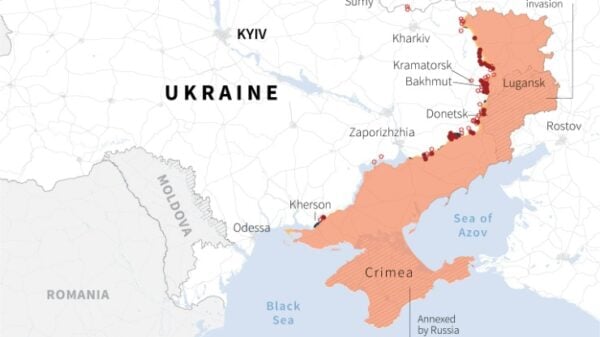
Defense spending was a hot topic at this year’s Farnborough as nations bolster their armed forces in the wake of Russia’s invasion of Ukraine.
Tempest was launched with great fanfare at the previous event at Farnborough in 2018 as part of Britain’s much-touted air combat strategy.
Defense giant BAE Systems is a member of Team Tempest alongside the British government, Leonardo, European missile specialist MBDA and British engine manufacturer Rolls-Royce.
Their goal is to develop a twin-engine stealth aircraft by 2035 that can be operated manned or unmanned, cannot be detected by radar, and will have impressive features such as laser-guided weapons and a virtual cockpit.
– battle cloud –
The consortium hopes to produce a breakthrough fighter jet capable of linking up with its own drones and other military warfare tools via a “combat cloud.”
Italy joined Team Tempest in 2019 and Sweden followed a year later.
Japan – which is already helping with engine and radar sensor technology – will now jump on board.
“An air combat demonstrator will be flying within the next five years,” said Richard Berthon, director of future combat air at the UK MoD, in Farnborough.
This preliminary demonstration version or pre-prototype is intended to test the proposed cutting-edge technology.
– “Once in a Generation” –
“This is an activity that happens only once in a generation,” said Herman Claesen, general manager of future combat air systems at BAE Systems.
“The last one was about 40 years ago for the (Eurofighter) Typhoon,” he said at the airshow’s Tempest event.
Eurofighter was developed by a European consortium of Great Britain, Germany, Italy and Spain.
It was originally conceived as a European fighter jet project in which France was involved.
However, Paris withdrew in 1985 and instead launched its Rafale fighter jet, produced by the French company Dassault.
The French government began exploring a future unmanned combat aircraft project with the UK in 2014, but this collaboration ended after Brexit.
All participants in these fighter aircraft projects strive to maintain the technological know-how in military aviation for decades to come.
So far, London has committed £2.0 billion (US$2.4 billion) and Rome 2.0 billion euros (US$2.0 billion) to Tempest over 15 years.
– Not far away –
In stark contrast to Tempest, Europe’s Future Combat Air System (FCAS) project, supported primarily by France and Germany, has faced stagnation over the past year.
Berlin, Paris and Madrid introduced FCAS in the summer of 2017 and want to develop their fighter jet by 2040.
The total bill is expected to be 100 billion euros, making it far too costly for a single country to fund.
Nevertheless, the FCAS program has had an extremely bumpy road.
France, Germany and Spain spent months negotiating how to share the complex workload that would move the project forward.
They eventually signed an agreement in August 2021 to invest a total of €3.6 billion in the initial phase of the project, known as Phase 1B.
Team FCAS had set itself the goal of launching its own flight demonstrator in 2025, which should then take to the skies two years later.
Since then, however, the airwaves have fallen silent for the planned high-tech European fighter jet.
Contracts have not yet been signed because French Dassault Aviation and main partner Airbus, representing Germany and Spain, have not yet reached an agreement.
Dassault has accused Airbus of making unnecessary “additional demands” that jeopardize the overall development and management of the project.
“We simply require that project management be respected… throughout the duration of the program,” Dassault chief executive Eric Trappier said on Wednesday.
– FCAS “will be successful”-
Dassault and Airbus are at odds over how to work together over the FCAS plane’s flight control central nervous system and its stealth technologies.
“We have agreed with Dassault to share workload and responsibilities – the difficulty is how we work together,” Airbus CEO Guillaume Faury told AFP on the outskirts of Farnborough this week.
“Negotiations are lengthy and difficult – but they are important and I am convinced that we will succeed.
“We have no choice – there would be no point in failing – the project is too important.”
#British #Tempest #fighter #project #rises #European #rival #remains #limbo