





















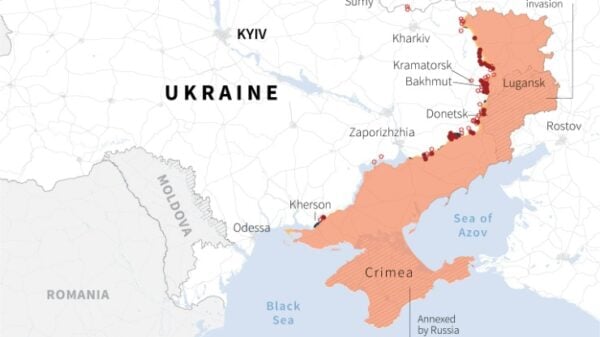



Talks are progressing on opening sea corridors to allow 20 million tons of grain still blocked in Ukraine and upcoming harvests to be shipped around the world.
But even if an agreement is reached, there will be no immediate relief for the importing countries.
– Crucial negotiations –
Negotiations have intensified since early June, with Turkey acting as an intermediary between Russia and Ukraine, which together cover around 30 percent of the world’s grain trade.
The talks are crucial as no other country has been able to make up the shortfall in the market of initially 25 million tons of Ukrainian grain. And soft commodity prices were already high before Russia invaded Ukraine on February 24, particularly as a result of the post-Covid economic recovery.
The war has pushed the prices of grains like wheat and corn to levels unsustainable for countries dependent on their imports, like Egypt, Lebanon and Tunisia.
In recent weeks, prices have gradually fallen back on the prospect of an upcoming harvest, recession fears and progress in the negotiations on the sea corridors.
Negotiations have accelerated in recent days: Turkey said an agreement in principle had been reached on creating a protected sea corridor.
Russian President Vladimir Putin said “progress” had been made in the discussions before telling reporters that any deal would depend on the West’s willingness to relent.
“We will facilitate the export of Ukrainian grain, but we assume that all restrictions related to possible supplies for export of Russian grain will be lifted,” he said.
However, market experts say that while no sanctions are aimed directly at Russian agricultural commodities, they are still being punished by sanctions against the country’s banking sector.
– What role does Turkey play? –
“There are only a handful of countries – Turkey is one, Qatar is another – that are able to talk to almost everyone and avoid a big backlash,” said Colin Clarke, research director of the US-based Soufan Group.
Turkish President Recep Tayyip Erdogan has “proved that he can do it, and that’s why he’s a trusted mediator not only for the Russians, but I think reluctantly for the NATO countries as well – that’s the best they have,” the expert said .
Turkey have “a strong hand to play here,” Clarke continued.
“Erdogan is allowed to play the hero, he can tell everyone that he is working to solve the global food crisis, but we know that Turkey is doing a lot to obstruct negotiations in other areas.
“They have their concerns, and their priorities don’t always align with the priorities of the international community, the priorities of NATO, or even the priorities of their allies.”
– What kind of deal? –
Up to 90 percent of Ukraine’s wheat, corn and sunflower exports were transported by sea, mainly from the port of Odessa, which accounts for 60 percent of all port activities in the country.
Any agreement to resume large-scale shipping will involve several phases: demining the ports mined by the Ukrainians; the loading of ships that could be placed under UN supervision; the inspection of the shipments; and escorting the boats, as required by Russia, to ensure the charges did not contain weapons, said Edward de Saint-Denis, a dealer at Plantureux and Associates.
However, diplomatic sources say that full demining is not necessary as safe transit routes remain in place in measures to protect coastal areas from invasion.
Many other points remain very controversial: if Moscow manages to control and even confiscate boats, will the controls be carried out in Ukrainian or international waters? Which ships are allowed to transport the shipments and what are the nationalities of their crews?
“Russians don’t want Ukrainians and vice versa,” said de Saint-Denis.
At one point, Turkey proposed using its fleet, but a compromise was reached to use “flags of convenience,” according to a market observer.
– What are the consequences? –
“In the short term, an agreement would lower prices, but the flow of grain shipments would not change immediately,” said Edward de Saint-Denis.
“It would take one to two months to clear the ports,” said the expert.
And the loading areas need renovation, particularly in Odessa, where part of the port administration was damaged in the fighting, he said.
Despite the various possible obstacles, agricultural market analyst Gautier Le Molgat said that it is now “in everyone’s interest that maritime traffic on the Black Sea resumes: primarily for the Ukrainians, but also for the Russians, who are planning an exceptional harvest have themselves export”.
#complex #negotiations #grain #Ukraine