






















With runaway inflation eroding incomes, staples have disappeared from the tables of Zimbabweans like Emina Chishangwe, who lives in a poor housing estate south of the capital, Harare.
“I can’t remember the last time I ate meat. It has become a luxury for some of us,” says the 57-year-old single mother of two adult sons.
According to Steve Hanke, professor of applied economics at Johns Hopkins University, Zimbabwe has the highest rate of inflation in the world, which he believes can only be fixed by fully adopting the US dollar.
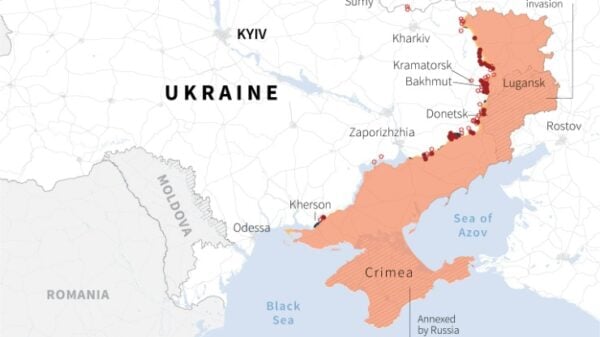
The situation has deteriorated rapidly this year as the Russian invasion of Ukraine, along with black market foreign exchange, has depreciated the value of the Zimbabwean dollar.
“The parallel market is largely responsible for rising inflation,” AgriBank chief economist Joseph Mverecha told AFP.
Zimbabwe’s economy has been in a downturn for almost two decades, marked by shortages of money and food.
Distrust has prompted people to exchange their cash for US dollars, further driving the local currency lower.
Inflation rose to 191.6 percent in June from 60 percent earlier in the year, driving commodity prices ever higher.
The rate even dwarfs the 41 percent inflation in war-torn Ukraine.
A kilo of selected beef now costs ZWL 8,768 ($21.92) and five kilos of chicken thighs cost ZWL 21,000 ($65.22) – the average monthly salary for a civil servant.
Chishangwe, who runs a vegetable stand in the city of Chitungwiza, and her sons eat two meals a day instead of three, usually a thick corn porridge called sadza and kale or small dried sardines.
– ‘Fear’ –
Rising fuel prices forced Edwin Matsvai to downgrade from a gas-guzzling Toyota Land Cruiser to a more fuel-efficient Honda Fit.
“My friends joked that I ‘resigned’ when I made the switch, but now some of them are considering following suit,” said Matsvai, a car salesman.
Gasoline rose to $1.77 per liter this month from $1.41 in January.
Zimbabweans endured and survived some of the worst hardships of 2008, when the central bank minted a $1 trillion bill in the wake of hyperinflation.
Growing disparities between income and the cost of living, forcing people to make tough decisions about how and where to live, are taking a toll on mental health, according to psychiatrist Isabel Chinoperekwei.
“I see a lot of them come with depression, anxiety disorders and also alcohol abuse,” said Chinoperekwei, who has a private practice in Harare.
It’s not just professionals who feel the fear.
“I’ve seen youngsters who switched schools because their parents could no longer afford the school they wanted to go to,” Chinoperekwei said. “They find it hard to deal with.”
Many blame the country’s leaders.
“The old men have let us down,” Matsvai said, referring to the government. “If they don’t act quickly and fix the economy, it will cost them in next year’s general election.”
In the by-elections in March, the long-standing governing party Zanu-PF lost to the opposition Citizens’ Coalition for Change (CCC), which had been founded almost three months earlier.
The South African nation is set to hold general elections in 2023.
– ‘hand to mouth’ –
Analysts say the current political and economic landscape is now mirroring the crisis that led to the 2008 election that almost saw ex-ruler Robert Mugabe ousted from power.
“People earning starvation wages, those out of work, and all those suffering from the rising cost of living have lost faith in Zanu-PF,” said Takavafira Zhou, political scientist at Masvingo State University.
“The only hope lies in a new government that gives (the public) respite.”
Zanu-PF has been in power since 1980, when British colonial rule ended. Current President Emmerson Mnangagwa succeeded Mugabe in a military coup in 2017 and vowed to fix the ailing economy he inherited.
The risk of losing power in upcoming polls is now driving Zanu-PF to “frantic action” to halt price hikes that have plunged millions into deeper poverty, economist Prosper Chitambara said.
“No governing party anywhere in the world is expected to do well in an environment of chronically high inflation,” said Chitambara of the think-tank Labor and Economic Development Research Institute of Zimbabwe.
Last month, Finance Minister Mthuli Ncube announced a series of monetary policy measures, including maintaining dual use of the US dollar, introduced after the 2008 hyperinflation, and the Zimbabwe dollar, reintroduced in 2019.
Minimum interest rates more than doubled to 200 percent last week.
The country is also introducing gold coins “as a store of value” from July 25.
But they are for the rich.
“Common people, those who fight and live hand to mouth, will not be able to afford it,” Chitambara said.
#means #Zimbabweans #battling #hyperinflation