






















Dark circles under his eyes, his beard closely cropped and dressed ubiquitously in khaki, President Volodymyr Zelensky is the face of Ukraine’s determination to expel Russian troops.
War has proved transformative for the 44-year-old former comedian, catapulting him from embattled leader of a struggling European outlier to a global household name and standard-bearer of opposition to Russian leader Vladimir Putin.
Yet his larger-than-life persona and seeming popularity could not have appeared more unlikely when the world rang in 2022.
As the champagne corks popped at New Year parties, Zelensky faced growing malaise at home. The novelty of a celebrity-turned-president was fading.
The electorate was struggling with living costs, corruption and fledgling social services. They were tiring of a populist who promised his presidency would be a panacea to the country’s problems.
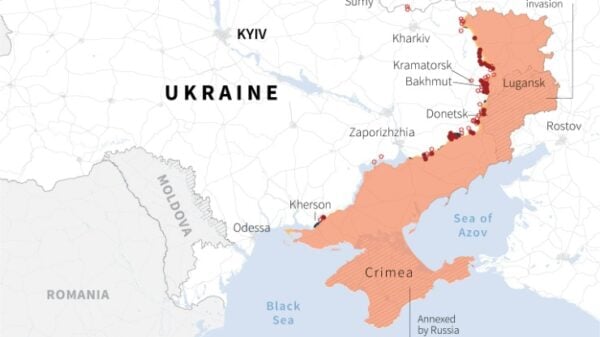
Fighting in the eastern Donbas region against Russian-backed separatists was worsening — despite his vows to bring peace. His rivals sensed weakness. Doubts were growing in Kyiv that he was the right man for the job.
Everything changed the moment that Putin ordered his army into Ukraine on February 24, hours after a bombastic fireworks display lit up the Kremlin.
“Before the war many treated Ukraine as a failed state and Zelensky as a weak and not totally competent leader,” said Volodymyr Fesenko, a Ukrainian political analyst.
– ‘We’re all here’ –
“The war radically changed people’s attitude towards Zelensky in a positive way. But he himself has also changed,” Fesenko told AFP.
The Russian invasion was a historic moment in a region embroiled by revolutions and conflicts over the three decades since the collapse of the Soviet Union.
“There were rumours Zelensky would flee. There was a feeling he was weak, that he wouldn’t be able to withstand the pressures of war and that he wasn’t capable of being a war-time leader,” Fesenko added.
In the war’s chaotic opening hours — with Russian tanks gunning for the capital — he calmly posted a video filmed outside government buildings in Kyiv with his closest aides in the frame.
“We’re all here, defending our independence and our country,” he said, looking directly into the camera.
In the months since — against a backdrop of credible allegations of Russian war crimes, the deaths of thousands and displacement of millions — Zelensky has made nightly addresses to the nation, 286 in total, promising them victory.
They have reason to hope. His appeals to the West for military and financial support, at times echoing the words of Winston Churchill, have seen Ukraine first halt Russia’s advance and then recapture swathes of territory.
Zelensky has made the case by presenting his country as the front line of a broader conflict and telling European leaders that Russia won’t stop at Ukraine.
– Blunt –
“Its ambitions are focused on the vast space from Warsaw to Sofia, from Prague to Tallinn,” he told…