


















Collapsed social services, financial hardship and fear: only brief excerpts trickle out of the everyday reality of Ukrainians in the Russian-occupied territories.
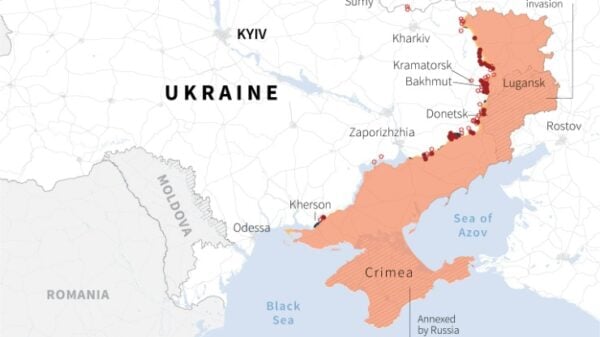
Territories that Moscow has seized since February’s invasion have been abruptly cut off from the rest of the country, and communications with those left behind are often patchy.
Several people living in three regions seized by the Kremlin gave grim accounts of the hardships and toxic atmosphere of suspicion for those living under Russia’s new rule.
Everyone’s names were changed to protect them from retribution and AFP was unable to independently verify their accounts.
– Kherson –
Cherson in southern Ukraine became the first major city to be captured by Russia when it fell to invading forces in the early days of the war.
Ukrainian forces are now trying to launch a major counter-offensive to retake the strategic region on the Black Sea coast.
Oleksandr, 25, is a teacher in a village near the city of Kherson:
“Liberating the city is one thing, but liberating the whole Kherson region is another. The Russians have set up defensive positions deep behind the front lines,” he told AFP.
“We know it won’t happen now, but we still have hope.
“The roads in the region are littered with numerous checkpoints and bombing raids can be heard over and over again.
“There are many soldiers in the cities, in Kherson, Nova Kakhovka, many helicopters and planes fly over the area.
“It’s very depressing in Cherson itself. Medicines are completely gone and many elderly people have died for lack of treatment.
“It’s hell for older people.
“If I had to describe the situation in one word, I would say ‘difficult’.
“There is a total collapse of public services. The military and the new authorities tell us absolutely nothing, except that they are here forever.
“The ruble is not in circulation. Passports are not issued – nobody wants them anyway.”
Russia has made the ruble the official currency in the territories it occupies and has started issuing Russian passports.
“Hyrvnias are in circulation, but there are major problems with cash.
“We have enough food, although very little humanitarian aid is being delivered.”
“Many people are unemployed, often only unskilled workers remain.
“People who had money and good jobs in technology or communication left at the beginning. Everything has stopped.
“Many activists were kidnapped in the first weeks of the occupation. There were big demonstrations against the occupation, but after a month they stopped because there is no internet, no communication.
“And all the activists are either in hiding or have been kidnapped or killed, I don’t know.
“When the Russians hear you speak Ukrainian, they think you’re a Nazi. They check social networks, tattoos, if you have Ukrainian symbols on your body, you are in trouble. I know some people have had their tattoos removed.”
– Lysychansk –
Antonina, 52, lives with her husband and adult daughter in the eastern city, which was captured by Russian forces in early July after heavy fighting.
“There are no authorities in the city, no gas, no water, no electricity. We can’t shower.
“There is very little humanitarian aid and there is still a lot of shelling.
“I don’t know if it’s possible to go, nobody has money for that anyway. Salaries have not been paid for several months.
“The internet is still working in some towns, like in Svatove, which is an hour’s drive away.
“Once a week people who can do that go there to make personal calls and call their neighbors who can’t travel.
“Some people make offers to go to Ukraine on a private bus, $600 or $700 per person, through Russia and Belarus, but a lot of people don’t believe it, they’re afraid of just being taken to Russia.”
– Balakliya –
Andriy and Tetyana are a teacher couple from Balakliya in the north-eastern region of Kherson, which has been occupied since early March.
Her daughter Anna, who lives on Ukrainian territory, described her experiences from the rare conversations she has with her parents.
“During the first months of the war, my parents continued to teach online. Then the internet went off.
“Then they called their students to give them homework. Then the phone was turned off. Now they are still officially teachers, but they are no longer paid.
“A lot of people left. In the beginning it was still possible. Now it’s not anymore.
“My parents told me that only two families lived in their four-story house.
“Some of the people who stayed don’t care about the country they live in – they support the new (Russia-installed) authorities.
“Sometimes they provoke my parents by telling them that from now on they have to teach Russian.
“My parents remain calm. At the beginning of the occupation, patriotic activists were kidnapped and even killed. Now everyone is calm.”
#Grim #fragments #life #ooze #Russianoccupied #Ukraine