






















#Whats #Putin #Ukraine #fight
Russian President Vladimir Putin must now decide his next steps in the five-month invasion he began in February.
After Russian troops captured the strategic Ukrainian city of Lysychansk on Sunday, security experts speaking to AFP suggested five different options:
– grinding feed –
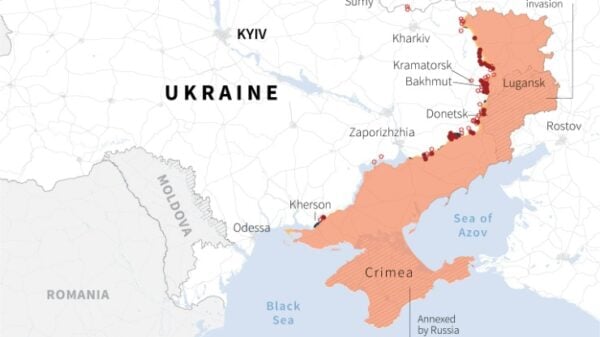
Russian forces appear to be on course to seize full control of the Donbass region, which was already partially held by pro-Kremlin separatists prior to the February 24 invasion.
Having captured Lysychansk and its twin city Severodonetsk in recent weeks, Putin’s troops “can hope to take Sloviansk and Kramatorsk and the surrounding regions,” said Pierre Grasser, a researcher at Paris’s Sorbonne University.
Sloviansk, in particular, is home to “a relatively hospitable population — at least those who stayed there,” rather than fleeing the fighting, he added.
But there may be limits to how far the Russians can penetrate into their neighbor’s territory.
“Their steamroller works well near their own borders, their own logistics centers and their air bases. The further away they are, the more difficult it becomes,” said Pierre Razoux, academic director of the Mediterranean Foundation for Strategic Studies (FMES).
– Control the Black Sea –
The southern Ukrainian city of Kherson was one of the first to fall to Russian forces in the early days of the war.
But Russia’s control of the country’s Black Sea coast is not secure.
“Ukrainian counter-attacks in the south…put Russian forces in a dilemma. Do they maintain their eastern offensive or significantly reinforce the south?” said Mick Ryan, a former Australian Army general.
The issue is all the more urgent as “the war in the south is a front of greater strategic importance” than Donbass, he added.
Claiming territory along the coast could allow Moscow to build a land bridge to the Crimea peninsula, which it annexed in 2014, while both sides want to control Ukraine’s Black Sea ports.
– crack Kharkiv –
Ukraine’s second-largest city, Kharkiv, lies near the northeastern border with Russia — and in a still-Kyiv-controlled pocket that could yet be cut off by Russian forces.
“If the Ukrainians collapse and Kharkiv is completely isolated, the Russians could force them before the election to commit to defending the city or relieve pressure in the south towards Kherson,” said Pierre Razoux.
It is up to President Volodymyr Zelenskyy and Ukrainian commanders to “deploy their forces to prevent a major summer breakthrough” that could encircle Kharkiv, he added.
A siege of Kharkiv, home to 1.4 million peacetime people, could be a bloody affair that could last up to a year, Razoux said.
– Divide the West –
While the West has so far maintained a largely unified front of sanctions and support for Ukraine, continued Russian advances could diverge allies’ assessments of their interests.
“Russia’s goal is to continue to wear down Ukraine’s forces on the battlefield while it waits for the political will in support of Ukraine to wane among Western countries,” said Colin Clarke, research director at the Soufan Center think tank in New York.
Deliveries of Western military aid were too slow and too small to turn the battle decisively in Kiev’s favour.
Meanwhile, the war’s inflationary impact on essentials like food and energy may gradually divert public opinion from strong initial support for Ukraine.
“Americans could tell Ukrainians they can’t go on,” said Alexander Grinberg, an analyst at the Jerusalem Institute for Security and Strategy.
– Open Conversations –
Russia itself is suffering the heavy costs of Western sanctions, battlefield casualties and losses of military materiel.
“Putin will eventually be forced to negotiate, he’s bitten off more than he can chew,” said Colin Clarke.
At the end of June, Kremlin spokesman Dmitry Peskov raised the option of talks – on condition that “all of the conditions set by Russia were met,” which Kyiv said were still unacceptable.
But his control of domestic information means the Russian leader has a free hand to tell the public his goals have been met and to justify a pause in fighting.
A greater challenge could be splits on the Ukrainian side.
Hardliners and military leaders would “reject any compromise with Russia,” even if Zelenskyy was willing to make a deal, Pierre Razoux said.
“They could tolerate a frozen conflict, but not defeat.”
Social Tags:
#Whats #Putin #Ukraine #fight